Renewable Resilient Society Summit, London, September 2024
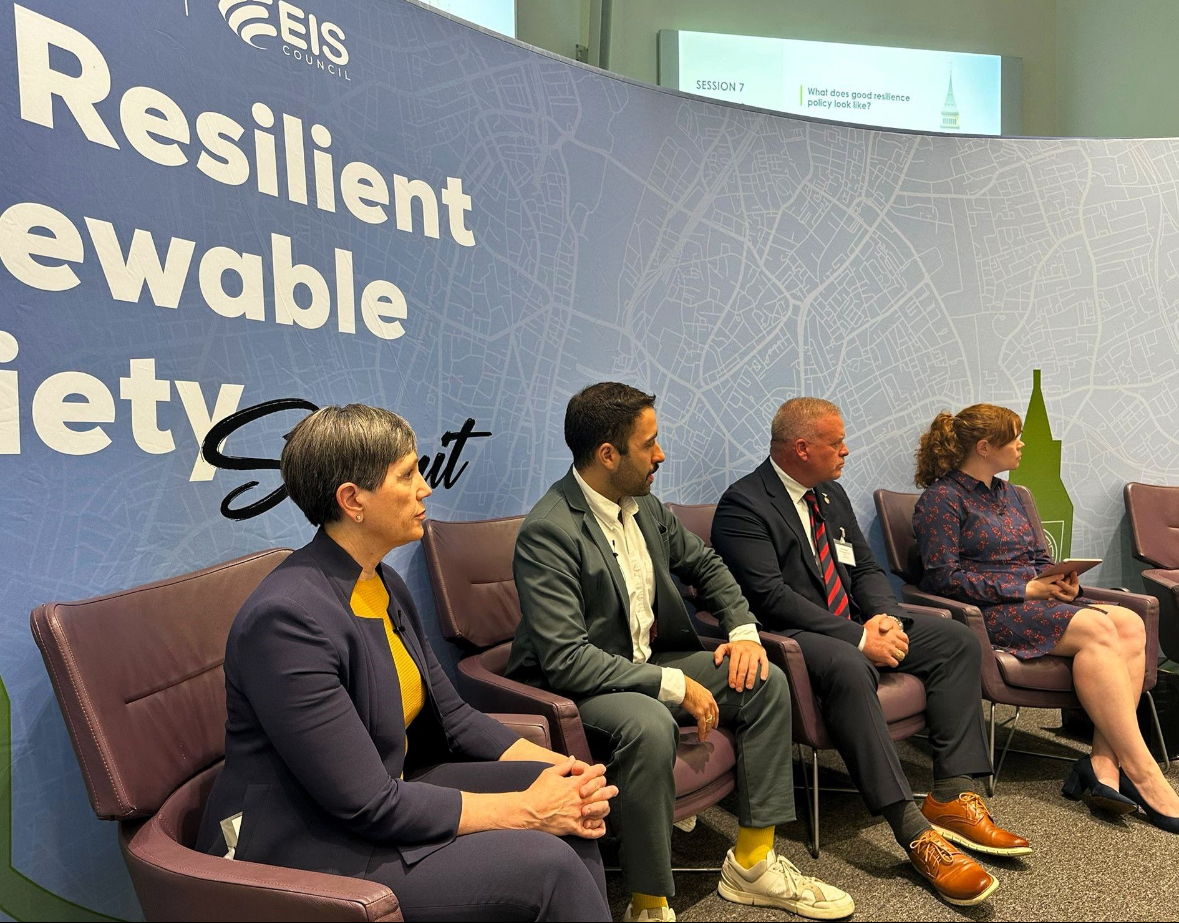
In September 2024 Gill Savage, Vice President – Global with the Australian Risk Policy Institute (ARPI) and Director of ARPI’s Centre for Advanced Resilience and Risk Policy Studies, participated in a panel session at the EIS Council and Imperial College Renewable Resilient Society Summit in London.
The many key points made by speakers included:
– Gill’s emphasis on the need for policy makers to be brave and adopt different models including ARPI’s Strategic Risk Policy®. The need to focus on the values we share to find common ground.
– The need for broad collaboration to build resilience.
– The need to inspire young people and embrace their creative solutions.
Below is a summary of Gill’s panel session.
As an introduction to my panel contribution, I will provide some comments on the Australian context. In the last year, Australia has experienced 242 extreme weather events impacting 81 local governments. Here are two examples:
– Last year, Fitzroy Crossing in northern Western Australia experienced severe storm and flood conditions due to ex-Tropical Cyclone Ellie. The cyclone caused heavy rainfall, went offshore, and returned inland, resulting in severe and widespread flooding. This was the first time Indigenous communities in this area had to be evacuated, and they were unable to return for almost three weeks. Indigenous communities have significant spiritual connections with the land, so being separated from their country resulted in high levels of distress.
– Earlier in 2024, a region in Victoria was affected by severe fires and, within a week, experienced extreme flooding. Residents were evacuated on both occasions.
Overlay these events with cybersecurity attacks causing significant data breaches in large telecommunications companies and health insurance providers, as well as the CrowdStrike event which impacted the business and aviation sectors.
Additionally, there is a cost-of-living crisis where grocery prices have increased significantly, and housing affordability is at its lowest level in 35 years. There is also the impact of extreme social media influencers on young males.
So, what does this tell us?
For some time, it has been highlighted that past decisions and actions have led to the current situation. These same factors will continue to influence future outcomes unless changes are made. Therefore, different approaches are needed.
What do policy makers need to do?
Be proactive. There is no perfect solution. Sometimes action is necessary, even if it means starting with imperfect solutions.
Consensus should be a goal rather than an outcome. Active engagement is important, but the best policy options must be pursued given the circumstances. This may result in some parties being disappointed; however, the aim is to minimise overall dissatisfaction.
Better leverage design thinking, which has become a substitute for consultation and engagement. Effectiveness requires leaving vested interests and preconceived views aside.
Embrace the 80/20 rule. Do not let the perfect become the enemy of the good.
Think differently. Different policy frameworks should be adopted. ARPI’s Strategic Risk Policy® enables senior decision-makers to engage with strategic risks by anticipating the potential impact of vulnerabilities. This involves protecting against foreseeable vulnerabilities rather than merely responding to crises.
Build vibrant local communities by enhancing regional solutions guided by principles-based national policies and frameworks.
Data analytics and techniques from various sectors, such as intelligence analysis, should be embraced.
Model cross-sectoral policy responses using digital twinning.
But how?
Start small and scale quickly. Use trials and pilots to test ideas and approaches. Abandon methods that do not work and build on those that do.